
Authentic experiences in Venice that actually support the city
GetYourGuide doesn't give a shit about Venice - here's who does.

Venice is sinking under the weight of around eleven million visitors a year - roughly half of which are day-trippers, and many who arrive, photograph the same two bridges (you know the ones), drink a fifteen-euro watered-down spritz on a heaving piazza, and leave without speaking to a single person who actually lives there.
The city has been so thoroughly optimised for tourism that it often optimises its own people out. The resident population has collapsed from 170,000 in the 1950s to fewer than 50,000 today, and it falls by roughly a thousand people every year. They leave because rents are impossible, because the shops they need have been replaced by shops they don't, and because living inside a place that exists primarily for other people's enjoyment can be an exhausting and demoralising experience.
Most travel content about Venice makes this worse, not better. The same lame experiences appear in the same 500 listicles and TikTok videos either because the creator gets a commission for sending you there, or simply because everyone else has already posted about them and repeating the same shit is easier than looking harder and actually caring. The sponsored gondola ride with an in-ear audio guide (kill me), the glass-blowing demonstration with 100 other people and high-pressure sales, the cicchetti tour run by a well-meaning but poorly versed and underpaid student from another town who takes you to crap places because they get a kick back… none of it is necessarily a scam, but these small indignities dressed up as authentic experiences do nothing for the city you came to see.
This article is a big fuck you to that entire system. Every experience here was chosen because it is run by someone with a genuine, personal investment in Venice - its crafts, its history, and its survival as a functioning city rather than a managed attraction.
First - a few words about GetYourGuide, AirBnB Experiences, and the rest of them
When you book an experience through a third-party platform, that platform takes a commission of typically 25–30% - sometimes more. That huge chunk of your money does not stay in Venice. It does not help a craftsperson cover workshop rent or fund a rower’s boat maintenance. It goes to a technology company, usually headquartered very far from the Adriatic, that has built a very effective business model on top of other people’s skills without being particularly invested in whether those people can actually sustain themselves long-term.
Guides, artists, and experience providers who list on these platforms are often forced to inflate their prices just to break even after the commission is taken - which means you pay more and they receive less. Many of the best operators have stopped listing altogether because the economics make no sense for them. The people doing the most genuine work in Venice are frequently the hardest to find through a search engine, not because they are obscure, but because they have opted out of a system that was never really designed to serve them.
The experiences I’m sharing below are all bookable directly, and I’ve given you links to them all
They are run by people were born here or arrived by chance or choice and never left. All of them are doing work that is harder to do than it looks - work that might disappear without people who actively seek it out and pay for it directly. These are not box-ticking activities, they are access to the real cultural fabric of a place that most visitors never find, offered by people who have spent years earning the right to share it. Craftspeople, athletes, artists, educators - people with workshops and boats and printing presses.
If you’re planning a trip to Venice and looking for more Venetian insight, this post also lives inside The Venice Index, my ongoing home for all things Venice on Substack. It is where I keep the context, the maps, and the places I return to again and again.
Now, let’s talk about some of my favourite things to do in the world’s most magical city…
Relight Venice Candle Workshops
Michela Bortolozzi is a Venetian designer who has worked and studied with artisans across Morocco, Palestine, and South Africa. She opened a studio in Cannaregio which she originally called Eat and Run - a cheeky reference to the tourism model slowly hollowing the city out. She renamed it Relight Venice in 2023, which is both a description of what she makes as well as a manifesto about how.
Every product in her workshop is a statement. The candles are cast in moulds she designed herself, shaped like the Gothic columns of the Ca’ d’Oro and Palazzo Ducale, made from wax recovered from Venice’s own churches, mounted on bases cut from leftover scraps of wood used in making oarlocks for the city’s traditional boats, with brass accents from the Fonderia Valese - the last surviving artistic foundry in the city.
From candles to edible lollipops, many of her objects pose a question that is really about Venice itself: do you consume it until it’s gone, or do you protect what makes it worth something in the first place?


It’s a beautiful place to shop, but getting involved in a hands-on workshop is even more meaningful. Her candle-making workshops are family-friendly, and available in both Italian and English. You’ll find the shop itself here and you can click here to learn more about her workshops and book directly.
Rowing Lessons with Venice
The voga alla veneta - Venice’s traditional standing rowing style - is how this city functioned for a thousand years. One oar, a carved wooden pivot called a forcola, and a figure-eight stroke that simultaneously propels and steers. It looks effortless, but it is not.
Row Venice was founded by Jane, a British-Australian expat who fell in love with the sport after moving to Venice and went on to compete in the Regata Storica (the city’s most important annual rowing event) herself. The organisation is a non-profit run almost entirely by women who are active competitive rowers, currently racing at national level and fighting for greater recognition of women in the sport. The instructors are a mix of born-and-bred Venetians and people who arrived from elsewhere and were claimed by the city - both categories know these waterways intimately.
In their signature lessons, you’ll learn how to row a batela - a traditional wooden boat visible in nearly every Canaletto painting, once the most common craft on the lagoon and now almost extinct. Lessons are private and run year-round. There’s a standard 90-minute session, an evening row down the Grand Canal, and a Cichetto Row that pairs the lesson with stops at traditional Venetian bars for food and wine - which is very much aligned with my Venetian priorities.
Book directly here.
Fondazione Querini Stampalia
In 1868, Count Giovanni Querini Stampalia left a will donating his entire family palace to the people of Venice, with the stated aim of promoting what he called “the cult of good studies and useful disciplines.” The foundation that opened the following year has been making good on that promise ever since - it houses a research library, runs a year-round programme of events, and keeps its doors open to the public with a degree of civic duty rather than pure performance. The upper floors remain largely as the family left them: a sequence of rooms filled with Venetian Baroque and Rococo paintings, furniture, ceramics, and a casual Giovanni Bellini altarpiece. Walking through makes you feel like you’ve transported back to the height of the Venetian Republic.
The ground floor is where the building does something unexpected. In the 1960s, Venetian architect Carlo Scarpa was given the ground floor to redesign. What he created is a sustained argument about how old and new can share space without either apologising. Canal water is channelled directly into the building at high tide which is mesmerising to witness. Every material seems chosen with an almost uncomfortable degree of intention and even if you arrive knowing nothing about modern architecture (like me) it’s incredible to view.


The library is open on Sundays, one of the only public libraries in Venice that is, and it is still genuinely used by researchers and locals. Your admission fee funds the maintenance of both the collection and the building - a 16th-century palazzo that requires constant, expensive attention. There are no shareholders or parent company. The money stays in Venice, doing exactly what a 19th-century count hoped it would, and I love that for him.
Click here to book tickets.
Book a Licensed Local Guide
Getting a tourist guide licence in Italy is not easy. It requires passing a regional exam that covers art history, architecture, local history, legislation, and foreign language proficiency - a process that takes years of dedicated study (and has a notoriously high failure rate). In a country with one of the richest and most complex cultural heritages in the world, the bar is set deliberately high, and the people who clear it have earned something monumental. I'm a licensed guide in Ireland so I know a fraction of the rigour that qualification demands - and trust me when I tell you the Italian system makes ours look straightforward.
This is not to diminish the many wonderful people running neighbourhood walks, food experiences, and themed explorations without a licence (some of whom you’ll find in the next section, and several of whom are outstanding). But if you want rigorous, accountable, deeply researched expertise in Venetian history and art, a licensed guide is where you start - and practically speaking, they are the only people legally permitted to guide you inside Venice's museums, palaces, and official heritage sites. If you want someone to take you through the Doge's Palace, the Accademia, or the Correr Museum and actually explain what you're looking at, a licence is not optional, it's the law.
Venice is one of the most layered, most historically dense, most architecturally complex places in the world, a city that was for centuries the centre of global trade, diplomacy, art production, and political intrigue, and almost none of that is legible to a newcomer from the outside without someone to unlock it. The building you walk past without a second glance turns out to be where a mental conspiracy was planned, or where a painter lived, or where a guild of craftspeople operated for four hundred years. The neighbourhood that looks like a quiet residential backwater has a history that rewrites everything you thought you knew about the rest of the city. A licensed guide doesn’t just know these things - they know why they matter and how to help you understand them.
A private licensed guide is also a fundamentally different experience from the group history tours you'll find on every third-party platform. Those tours… with twenty-five people, a shared audio receiver, the flag of shame, and a pace set for the slowest walker… are designed for income generation, not understanding. A private guide shapes the experience around you: your interests, your pace, what catches your attention, what you want to go deeper on. You can ask anything, double back, linger. It costs more than a group tour, of course, but it’s worth every cent.
Here are two licensed Venetian guides I trust and book regularly for my private travel clients:
Elisabetta Amadi: A sixth-generation Venetian, Elisabetta brings an inherited intimacy with the city to everything she does. She covers art, architecture, and history across Venice and the wider Veneto, and has a particular gift for the hidden and overlooked corners of the city. Her website and contact info are here.
Romena Brugnerotto: Born and based in Venice, Romena is a licensed tour leader and certified sommelier with a degree in Cultural Heritage. Alongside her art and history tours she also runs food, wine, and bacaro walks. Her website and contact info are here.
Spend Time With Some of My Favourite Locals
Some of the most valuable time you can spend in this city is with people who know it intimately because they live here, grew up here, work on the water, or have spent years building a deep and specific relationship with a particular corner of it.
These are two of my favourite locals who can show you around:
If you want to get out on the water to explore the lagoon, look no further than Matteo. A born-and-bred Venetian who spent years working on ships and yachts before bringing that experience back home, Matteo runs private boat tours out to islands like Murano, Burano, Torcello, and the rarely-visited San Francesco del Deserto, a private island with five resident monks. He knows the lagoon intimately and has the local connections to get you into places and experiences you simply couldn't arrange on your own. His website for booking direct is here.
Gillian Longworth McGuire is someone I’d trust blindly when it comes to Venetian recommendations. If you’re looking for a relaxed and informative neighbourhood stroll or impeccable insights on shopping, sightseeing, etc in real-time, get in touch with her about her services. You can meet up with her in Venice and I guarantee it’ll be a highlight of your trip.
Printmaking with Plum Plum Creations
Venice has one of the most significant printmaking histories of any city in the world. By the end of the 15th century, nearly 200 printing presses were operating here. The city was a magnet for printers, humanists, and publishers from across Europe precisely because it guaranteed freedom of the press and rewarded craft (can we bring this back, please?). That tradition (of making images by hand, one plate at a time) is what Arianna is keeping alive from her studio on my favourite fondamenta in Cannaregio.
Plum Plum Creations, which she opened in 2016, is a working studio and shop where Arianna makes original prints using traditional techniques like etching, drypoint, aquatint, and linocut. She draws inspiration from her surroundings - palaces, canal corners, architectural details, and local nature. I have been slowly collecting pieces from her shop over the years.
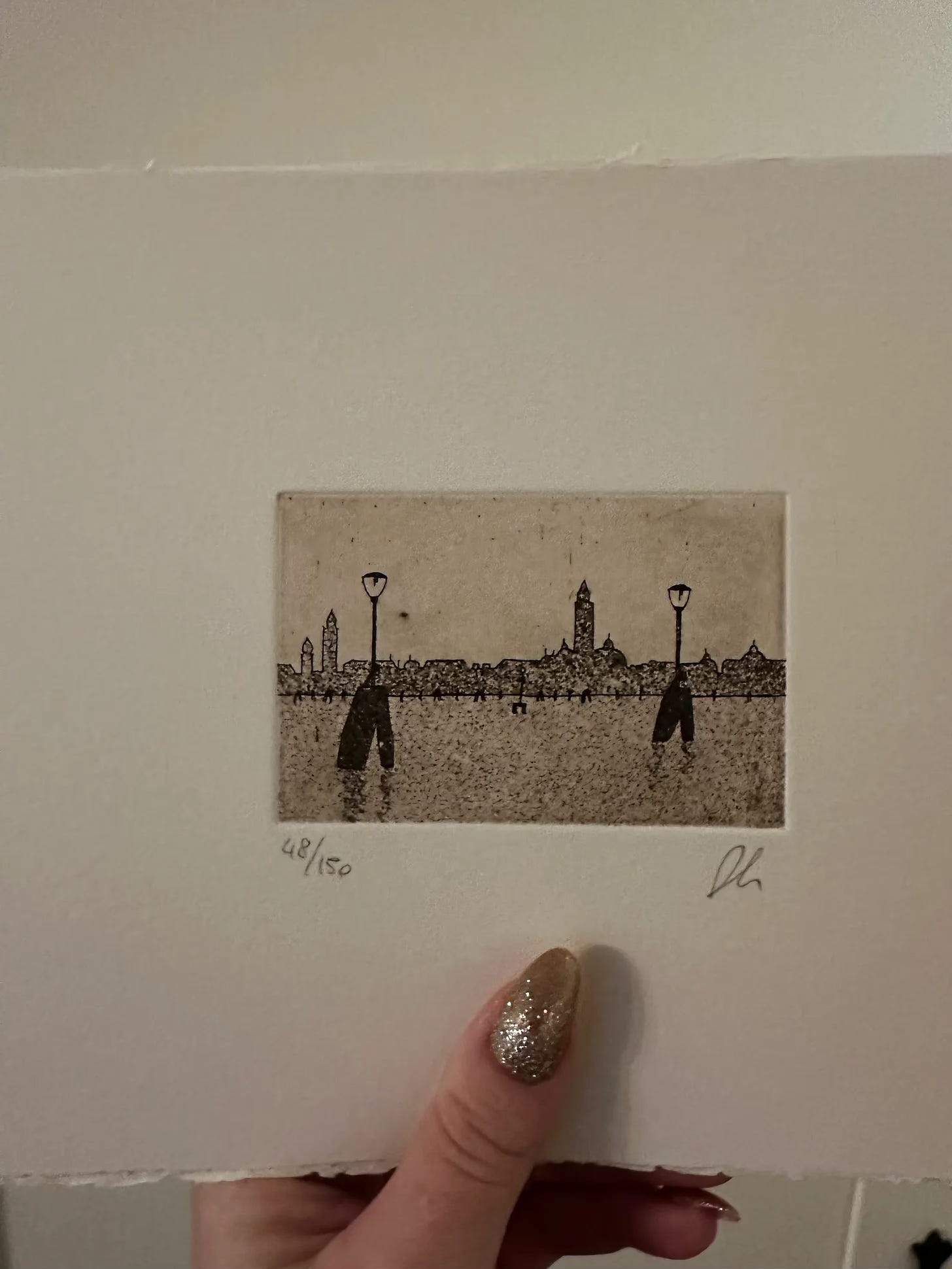
Her workshops are a unique opportunity to step into the complex world of creating prints. Arianna takes a maximum of two people at a time and walks you through the entire process from plate preparation to final print, helping you choose your subject and guiding every stage. Sessions run from a few hours to a full day depending on how deep you want to go, and no prior experience is required. You leave with prints you made yourself in a Venetian studio using a technique that Venetian artists have practiced for five centuries and that, my friends, is one hell of a souvenir!
You can click here to learn more about the options and book directly.
Paper Marbling with Arzanàrt
Marbled paper arrived in Venice around 1600 and found fertile ground in a city that was already one of the great centres of European bookmaking. By the 17th century Venice’s legatorie, or bookbinding studios, were producing books at enormous scale, and the swirling, stone-like patterns of marbled paper became their signature decorative element. The technique is deceptively simple in principle - oil-based pigments floated on water, manipulated with combs and rakes into patterns, then transferred to paper in a single contact - but endlessly complex in practice. No two sheets are ever the same.
Arzanàrt is run by Isabella and Federico, who opened the studio in 2018. Isabella holds a degree in Cultural Heritage from Ca’ Foscari University and it was during her studies that she first encountered marbled paper. She later learned the technique in Florence, and then spent years refining it at home before feeling ready to open the workshop. Federico, a native Venetian, focuses on developing new colours, patterns, and forms, pushing the tradition without abandoning it. The studio is both shop and atelier - sheets of paper cover the walls and racks, alongside notebooks, jewellery, and objects. On my desk sits a proud marbled paper pen holder from their studio, and I love looking at it every day
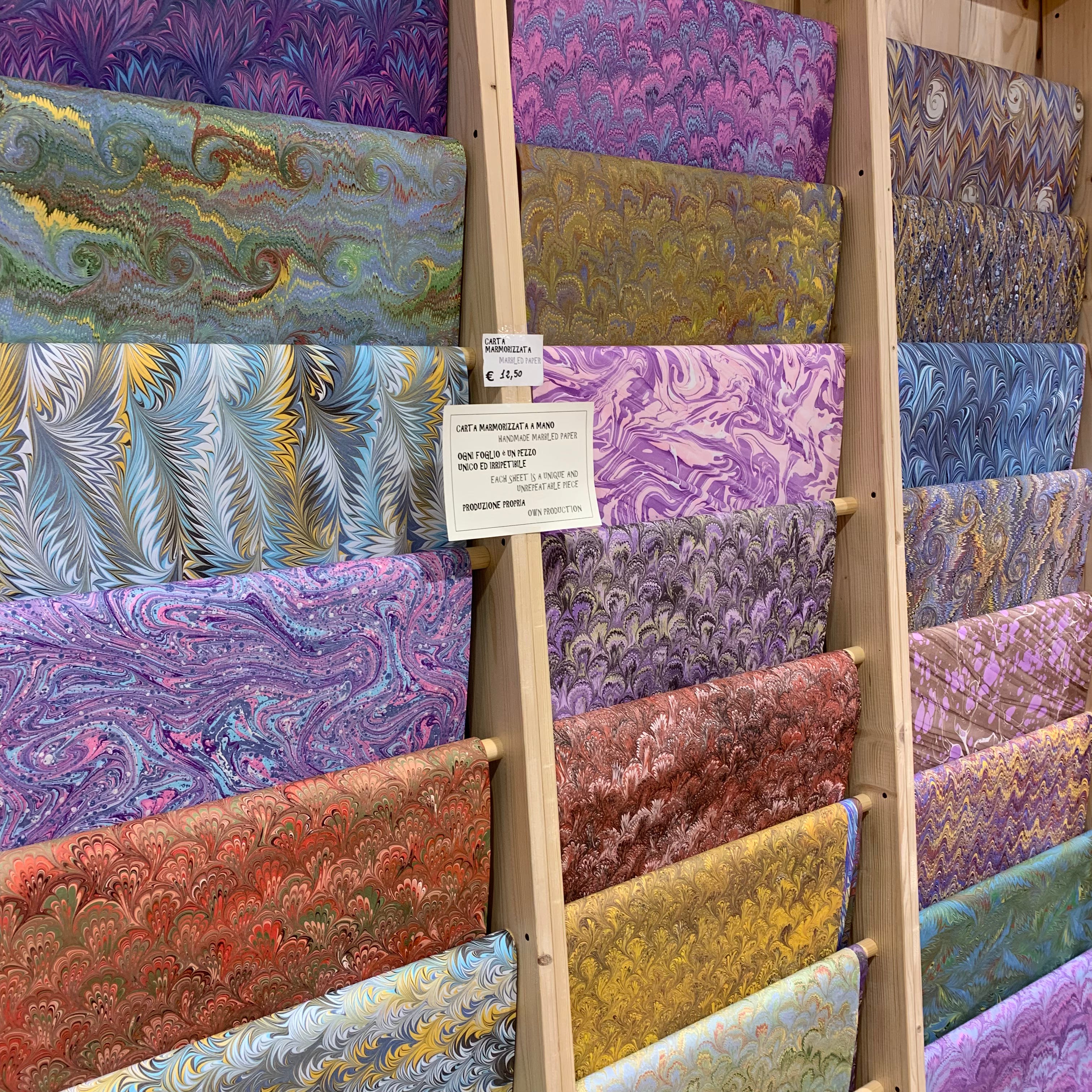
Their two-hour workshops run morning and afternoon, and take you through the process from the simplest patterns to the more elaborate, working at your own pace. You leave with everything you make (up to ten sheets). Workshops are conducted in English or Italian and can be booked as private or shared.
You can click here to visit their website, learn more, and book directly.
Thank you for reading!
Every person and place in this guide has been chosen because they are doing something worth protecting - work that is harder to sustain than it looks, in a city that makes sustainability harder every single year. If you have questions about any of these experiences, want a more personalised recommendation, or are planning a trip and want help thinking it through, you can reach out to me on hello@yourgrandtour.com
And if you found this useful, please share it with someone who's going to Venice - especially the kind of traveller who will actually make good use of it!
Fantastic. I love it all but especially the printmaking and the paper marbling. ❤️