
History I Can't Shut Up About: Veronica Franco
My favourite Venetian woman who demolished men with prose, slept with the King of France, and schooled the Inquisition.

In 1575, a Venetian woman published a book of poetry so sharp and so unapologetically written from the perspective of a woman who understood her own desire that it should have made her immortal. She was tried for witchcraft by the Inquisition and walked out acquitted, defended by a room full of powerful men who crossed the Catholic Church to stand with her. She tried to build a refuge for the women the city had used and discarded. She wrote letters, she wrote verse, and by god she wrote back at any man who came for her in print. She died in poverty at forty-five, and history filed her under "courtesan" and moved on. Today I am here to scream about her from the rooftops.
Her name was Veronica Franco, and she was one of the most remarkable people the Renaissance produced.
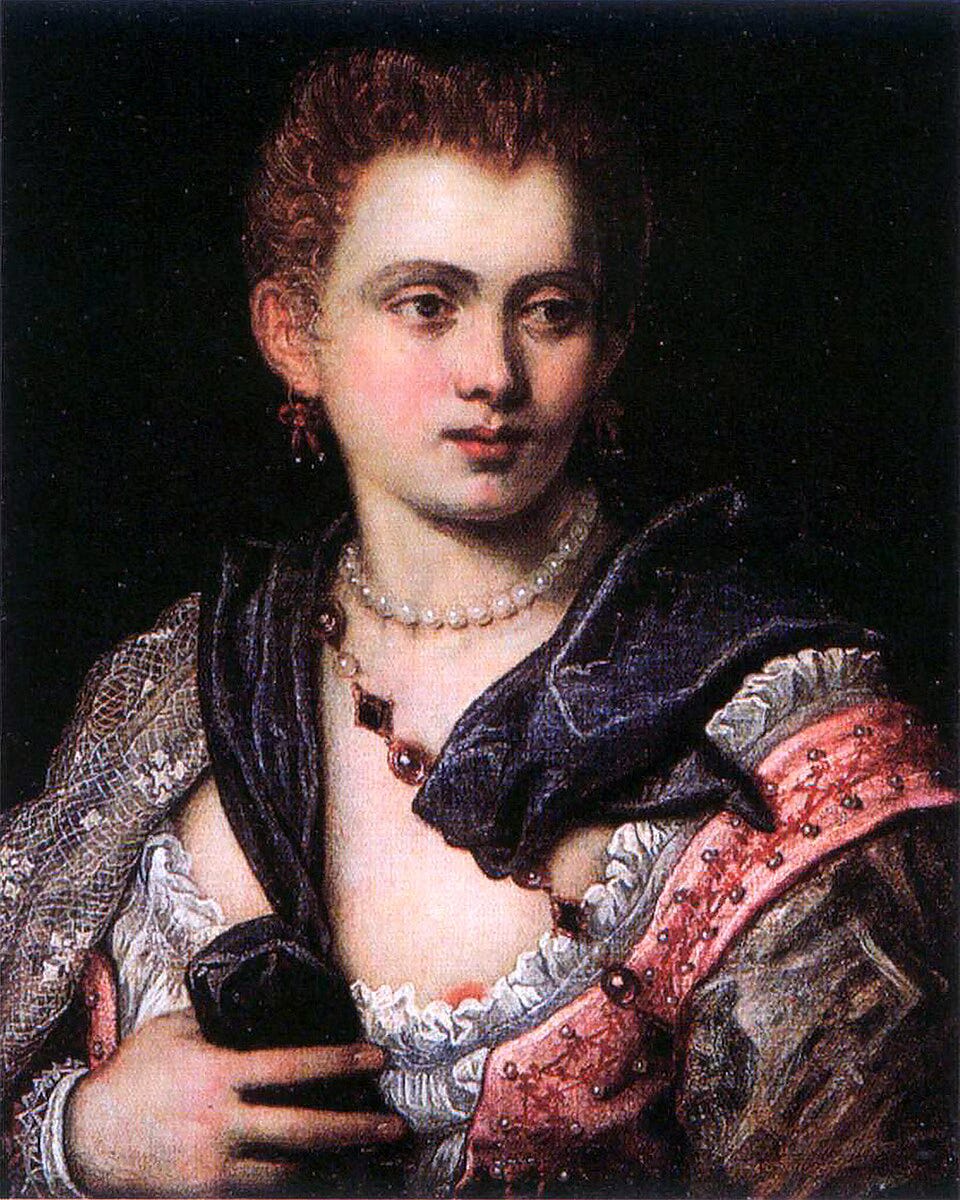
This post is part of my History I Can’t Shut Up About series, where I rescue eccentric, brilliant, frequently wronged dead people from the footnotes they were shoved into and make them take up the space they always deserved.
Standard disclaimer: I am a qualified postgraduate historian, but I have no interest in making this a dry lecture. I care about people, patterns, and the parts of history that make you want to crawl through a page and punch someone. If you want piles of footnotes, I respect that, but this is not that post and you are not my dissertation supervisor. If you want context, fire, and a genuine attempt to write a woman back into her own story - you are absolutely in the right place.
Now, let’s set the scene…
The Most Beautiful Double Standard in Europe
To understand Veronica Franco, you first need to understand her Venice. By the sixteenth century, Venice had spent centuries building itself into one of the most powerful trading empires in the world, constructed on water like some kind of dare, covered in gold and magnificence. It was a republic (technically) governed by an elected Doge and a series of councils so labyrinthine that half the city’s energy went into simply understanding who was currently in charge of what. It was wealthy in the way that makes people strange (my favourite breed of wealthy) and it was beautiful in the way that makes people reckless. It was also, and this is relevant, absolutely heaving with contradiction.
Venice liked to present itself as orderly, civilised, and governed by law. It was also a city so comfortable with its courtesans that it printed them into a directory - with names, addresses, and prices, for the convenience of visiting gentlemen. The republic that prided itself on virtue was simultaneously running what amounted to the most sophisticated sex tourism infrastructure in Europe, and doing it with full civic awareness.
What made Venice unusual wasn’t just the canals or the carnivale or the light that painters kept losing their minds over (I still do) but that particularly Venetian cocktail of spectacle and social performance that ran through everything. The city understood, perhaps better than anywhere else in Europe, that how things looked mattered as much as how they were, and it built its entire identity around that idea. This would turn out to be, for certain women, a very specific kind of opportunity.
Like any city built on trade, Venice understood that keeping money in the room was half the battle. The city had wealthy, powerful, well-travelled men coming and going constantly - think merchants, diplomats, and foreign nobles - all with time and money and no particular interest in going home early. The republic had a vested interest in keeping these people entertained, present, and spending.
Enter the cortigiana onesta - the honest courtesan. And if you think the name is a contradiction, you have no idea what this city was capable of. This is the Venice that made Veronica possible: loud, gorgeous, and morally flexible.
The Cruel Maths of Being a Renaissance Woman
The cortigiana onesta sounds extraordinary, because they were. But before we get completely swept up, we need to talk about the world these women existed in. Veronica Franco was exceptional, and exceptional is only meaningful when you understand what she was the exception to.
Let's talk about what your options actually were if you were a woman in sixteenth century Venice, because the list is short enough to make you want to put your head through a wall.
Option one: marriage. You married young, usually to a man your family selected for economic or political reasons that had nothing to do with you, and you became his legal property. Your dowry would be transferred to his control, your movements were restricted, and your body was available on his terms. You managed his household, raised his children and, if you were very lucky, he was not cruel. Most women in Venice lived in this state of confinement - expected to stay largely indoors, kept away from public life, and treated as assets. The walls of a respectable Venetian home were not entirely unlike the walls of a very well-furnished prison.
Option two: the convent. Families who couldn’t afford a dowry, or who had surplus daughters, sent girls into religious life whether they wanted it or not. Venice had convents packed with women who had not chosen God. Some of those women built remarkable lives within those walls, but many of them did not.
Option three, available only to a very specific and carefully trained few: the honest courtesan. The cortigiana onesta was not a street prostitute - that was an entirely different and far more brutal category of existence. She was educated, cultured, spoke multiple languages, played instruments, and could hold her own in philosophical conversation. She was able to move through intellectual and social circles that were entirely closed to respectable married women. She had her own household, and often she chose her own clients and negotiated her own terms. She had access to libraries, to salons, and to the kind of stimulating company and genuine intellectual freedom that Venetian wives (locked behind their very nice front doors) could never even imagine.
So the women with the sharpest minds and the most freedom in all of Venice were the ones the city agreed to treat as disreputable.
The cortigiana onesta paid for her freedom with her respectability, her security, and the constant anxiety of a life that depended entirely on her continued desirability. There was no pension or safety net, and age was your worst enemy (some things never change, am I right ladies?). The city knew exactly what it was doing when it built the whole arrangement - it got educated, cultured, entertaining companions for its wealthy men, but it got to look down on the women providing that service at the same time.
This is the world Veronica Franco was born into… and her mother, who knew exactly how this world worked, decided to teach her daughter how to survive it.
Enter Veronica
Veronica Franco was born in Venice in 1546. Her mother, Paola, was herself a cortigiana onesta - and before you read that as tragedy, hold on, because this requires a moment of my favourite thing - ✨historical context ✨. The instinct from a modern perspective is to find this horrifying… a mother steering her daughter towards prostitution? But if you take a few steps back and remember we are not talking about 2026 you’ll understand that Paola knew exactly what the alternatives looked like. She had watched what happened to women who married badly with no resources, no education, and no leverage. She had also watched what happened to women who ended up in the cheaper, more dangerous tiers of Venetian sex work, where there was no choosing your clients and no way out.
The cortigiana onesta life, done well, offered something genuinely rare: income you controlled, a household you ran, and intellectual freedom. Paola was handing her daughter the best toolkit she had. She was a woman who understood the system she was operating in with complete clarity, and she made a decision that would shape her daughter’s entire life: she would train her.
Veronica received an education most Venetian women at the time could only dream of - languages, music, literature, philosophy, the art of conversation, and how to manipulate powerful men. While girls from patrician families were being prepared for confinement, Veronica Franco was being prepared for the whole fucking world.
There’s a moment that’s often missed out in her story which I find interesting, because it tells you something important. As a teenager, Veronica was briefly wed to a doctor. In my opinion, this marriage was almost certainly Paola’s attempt to secure her daughter’s position through respectability first. A doctor was a reasonable match, a sensible plan, even - but somehow it completely fell apart. The marriage was dissolved, and the exact reasons for that are sadly lost to any records we have… though given what I know of Veronica’s personality and ambitions, I have my theories that she found a doctor’s household about as appealing as the convent - and something led her back to her mother’s home.
Dissolving a marriage was not a simple thing to do, and it carried stigma. Most women would view it as narrowing their options, but for Veronica it opened a door.
None of this was passive or happenstance. Veronica Franco was sharp as hell, and incapable of taking up less space than she deserved. She looked at the world she'd been handed, identified the one door that was slightly ajar, and kicked it clean off its hinges. The courtesan life had given her an excellent education as well as something Venice denied almost every other woman: a standing invitation into rooms full of the most literate men in the city. Most women in her position used that access to charm, Veronica used it to write. She picked up a pen, and let me tell you - the men of Venice had absolutely no idea what was coming.
The Woman Who Brought a Pen to a Sword Fight and Won
In 1575, Veronica Franco published a collection of poetry that announced itself from the very first page as something different. Not just because of what she wrote, but because of how she chose to write it. She used terza rima - Dante’s form - the interlocking three-line stanzas of the Divine Comedy. This was the most prestigious poetic structure in the entire Italian literary tradition, the form every serious Italian poet measured themselves against. Veronica Franco, a woman the church considered morally compromised, picked it up and used it to write about female desire and her own body. It is hard to overstate how little precedent there was for this. Respectable men wrote in terza rima. Women, when they wrote at all, either wrote of God or kept quiet. A courtesan writing of her own pleasure in the form of the Divine Comedy was not a small transgression of the rules… there were no rules for it at all, because no one had imagined it would need them.
Before we go further, I want to flag something important: Veronica’s poetry is in Italian (obvs), and the translations you’ll find vary wildly in quality. Some of the translations I kept returning to while I referenced for this article are the ones by poet and translator Michael R. Burch, who has done a beautiful job of rendering her words into English right here on Substack (god I love this community). He captures something which some academic translations miss: the fact that she was not just intellectually sharp, she was deliberately sensual, and she wanted you to feel that.
Veronica wrote from the inside of her own life. She wrote about pleasure as something she experienced and understood, not just something that happened to her. She was unapologetically erotic in an era when female desire was something to be managed and suppressed.
In one poem she describes herself in bed with a man, translated by Michael R. Burch:
“Becoming completely free
With the man who freely enjoys me”
There is a complete absence of shame around it. This is a woman who looked at everything society wanted her to feel about her own desire and basically said yeah, fuck that. She also wrote that she had resolved to make a virtue of her desire. There is nothing defiant or defensive in it - it reads like a woman settling a question that was never actually in dispute, at least not for her.
This is the part that drove a certain kind of man up the wall. Not the desire, the lack of remorse about it. A guilty woman they could work with. A woman writing about her own pleasure as if it were nobody's business but hers was a threat to the entire arrangement. Veronica Franco was never going to hand anyone the apology they were waiting for, and at least two men took it extremely personally.
Meet the Veniers.
Veronica had moved into the orbit of Domenico Venier’s prestigious literary salon (one of the most important intellectual circles in Venice) and it was there she became entangled with two of his relatives in ways that would produce some of the most extraordinary poetry of her career.
The first entanglement was Marco Venier, a nobleman and poet who was almost certainly a lover, someone she addressed in her early poems as an intimate and an equal. That relationship eventually curdled and, when it did, Veronica processed it the way she processed everything: she picked up her pen. I’m really struggling to not work in five pages of Taylor Swift comparisons here - a female literary genius who broke countless rules and had horrible men in her orbit - but that's another essay in its own right.
A quick note on sourcing: the translations of Capitolo 13 and 16 throughout this section are by Ann Rosalind Jones and Margaret F. Rosenthal, from their edition Poems and Selected Letters (University of Chicago Press, 1998), which is the standard scholarly edition and the one to read if you want her in full.
Capitolo 13 (Swifties here with me, it’s a sign - am I right?) opens mid-fury, addressed to a man who had been close to her and then turned on her. "No more words! To deeds, to the battlefield, to arms! For, resolved to die, I want to free myself from such merciless mistreatment." She challenges him to a public duel in verse. She threatens to rip his heart from his chest and his deceiving tongue from his mouth - and then, just as you think you know what kind of poem this is, she pivots. She turns to her bed… the bed they shared. The battlefield and the bedroom become the same room. The anger and the grief arrive together, inseparable, and you understand that this is not a poem about hatred, it is a poem about what betrayal actually feels like when it comes from someone who was inside your life, inside your home, inside your most private space. It’s giving The Smallest Man Who Ever Lived. She ends by reaffirming her desire for revenge, even if it kills her. The whole poem is so deeply devastating because she never pretends the love wasn't real, she is furious that it was.
The second entanglement was uglier, and Veronica Franco was so catastrophically overqualified for it that it almost makes you feel sorry for him. Maffio Venier, Marco's cousin, was a dedicated misogynist who had decided that the correct response to a brilliant, successful, widely admired woman was to write a series of obscene anonymous poems in an attempt to degrade her - because nothing screams "I am completely unthreatened by this woman" like hiding behind a pen name to call her a whore. He was, by every account we have, a man who responded to female excellence the way a damp cat responds to a bath - with a lot of noise and absolutely zero dignity.
It didn’t take Veronica long to find out it was him who wrote the slander. She offered him a public duel - in verse - and he declined, which was the first sensible decision he had made in this entire sorry saga, because Veronica had already written Capitolo 16, and in it she had already won. He had called her, anonymously, a "unique whore," and Veronica took the insult apart on the strength of a single word. Unique, she noted, is properly used only for excellent and singular things, which meant Maffio had reached for a slur and handed her a tribute instead. She accepted it graciously, then addressed him, and every man like him, with this:
‘When we women, too, have weapons and training, we will be able to prove to all men that we have hands and feet and hearts like yours; and though we may be tender and delicate, some men who are delicate are also strong, and some, though coarse and rough, are cowards. Women so far haven't seen this is true; for if they'd ever resolved to do it, they'd have been able to fight you to the death. And to prove to you that I speak the truth, among so many women I will act first, setting an example for them to follow.”
This was a promise, in print, under her own name, to a man who had tried to destroy her anonymously and could not even manage that. The irony Maffio Venier never lived to appreciate is that he is only remembered because he picked a fight with the one woman certain to outwrite him, and handed her the occasion for one of the boldest things any woman published that century.
That Time the King of France Showed Up
In the summer of 1574, Henry III of France stopped in Venice on his way home to claim the French crown, having just abandoned the throne of Poland the moment a better one came free. He was twenty-three, between kingdoms, with time to kill and most of a continent watching, which made him precisely the kind of guest Venice lived for.
Venice, being Venice, being constitutionally incapable of letting an opportunity for spectacle pass without wringing every last drop from it, lost its collective mind. The Republic threw him a reception so excessive it earned its own place in architectural history. Palladio designed him a triumphal arch. Veronese and Tintoretto handled the decoration. There were regattas, there were banquets, and there was a glass-blowing display mounted purely to show off. The entire production existed to remind one young, impressionable monarch that Venice was the most sophisticated and most beautiful city on earth and that he would be wise never to forget it.
In gathering up the very best of what it had, one of the people the Republic chose to present to the king was Veronica Franco. Venice spent its ordinary days treating her as a line item, a name in the courtesan registry, a woman it was happy to profit from and happier still to look down on. Then the most important guest in a generation arrived and all that careful disapproval evaporated. Suddenly she was not a moral inconvenience, but the city's finest export, the thing Venice most wanted a monarch to remember.
Veronica gave the King two sonnets and a small portrait of herself, and then she gave him the rest of the night, because the part history likes to fold neatly into “the king was charmed” is that Henry III, freshly sprung from one throne and on his way to another, slipped early out of the most expensive party Venice had ever thrown for anyone and went straight to bed with her. The entire Republic was performing itself at full volume for this one young man, and the entertainment he actually wanted turned out to be a few hours alone with a courtesan the church would happily have seen run out of town. The state banquet was simply a bit of foreplay.
Veronica wasn’t even remotely shy about what she had offered him, because the sonnet she wrote to mark the occasion is no polite thank-you note but a seduction on paper, telling the King of France that if he thinks her dear to Phoebus for her poems he will find her dearer still to Venus, which is a sixteenth-century way of saying my writing is great but my sex is even better and I know it. Anyone in Europe who could read would understand precisely what the King of France had crossed a city to get and precisely how good she considered herself at providing it.
This is the whole engine of Veronica Franco running at full power. She was hired as a luxury, treated as a national asset, taken to bed by a king, and then she turned the entire episode into literature on her own terms, casting herself not as the grateful recipient of royal attention but as the one who had the thing worth wanting. He got a night, but she got a poem that outlived his dynasty. Some sources go further and claim the encounter had real teeth, that Henry left so taken with her that he threw French naval support behind Venice against the Ottomans, which would make her possibly the only woman of the century whose performance in bed registered as foreign policy. Honestly, I wouldn’t put it past her.
In any case Henry went home, was crowned, and managed one of the more catastrophic reigns in French history before a fanatical friar stabbed him to death fifteen years later. The triumphal arch came down and the regattas were forgotten, and the most durable thing to survive the most extravagant state visit Venice staged that decade turns out to be two sonnets, a portrait, and one woman's published, unapologetic boast about a night with a king.
The Shelter That Never Got Built
The part of this story so many romantic retellings tend to skip is the part that tells you most plainly who Veronica actually was. At the height of everything, with the salon connections and the published book and a king in her recent past, Veronica Franco turned her attention to the women who had nothing. She knew exactly who they were, because she had grown up alongside them and watched the system sort them: the women pushed into the more dangerous tiers of Venetian sex work, the ones with children and no protector and nowhere to go when their desirability ran out, the ones the city used up and then pretended not to see. In 1577 she put a formal proposal to the Venetian authorities for a house where those women and their children could go, a refuge for the ones the Republic had built its pleasures on and then discarded.
Her proposal was radical because she refused to assume. Venice already had institutions for fallen women, but they ran on the premise that such women were a moral stain to be scrubbed clean, taking them in only on the condition that they renounce their old lives and submit to something close to confinement. Veronica’s proposed house carried no such condition - it was conceived not as a place of penance but as a place of shelter, somewhere a woman could go because she needed help rather than because she needed correcting, and that small shift in premise was the most subversive thing about it.
Around the same period she wrote a letter that has miraculously survived, addressed to a mother who had come to her for advice about steering a daughter into the courtesan life. Veronica told the woman not to do it. The same Veronica Franco who had been trained for this life by her own mother, who had built everything she owned inside it, who understood its freedoms better than almost anyone then living, looked at this particular girl and said no. She described the work with a frankness that is hard to read even now, writing of a woman forced to eat with another’s mouth and sleep with another’s eyes and move always at another’s will, running headlong toward what she called the inevitable shipwreck of her life. Both of those truths lived in her at once, the freedom she had found and the wreckage she had seen it make of women with less luck and less talent.
Veronica’s refuge never got its funding. The government that had grown rich and famous on the backs of its courtesans turned out to have no particular appetite for housing them once they were no longer useful, which will astonish nobody.
The Inquisition Would Like a Word
In 1580, the same year her book of letters was published, Veronica Franco was denounced to the Venetian Inquisition by a household tutor named Ridolfo Vannitelli, a man whose theological concerns were, let us say… recently acquired. By the most credible account she had just accused him of robbing her house, and the denunciation was his rebuttal. Unable to win the argument about her missing jewellery, Vannitelli reached for the largest object within grabbing distance, which in sixteenth-century Venice happened to be a charge of witchcraft.
The Inquisition did not need evidence, and that was precisely the problem. It was the machine Catholic Europe built to hunt heresy, and its real talent was psychological: a century spent teaching people to snitch on their neighbours before their neighbours snitched on them. Being accused was already three-quarters of the catastrophe. Venice, to be fair, ran a comparatively sane operation, less keen on the elaborate horrors staged elsewhere and less willing to set its courtesans on fire, which I include not as praise but because that is genuinely how low the bar was lying. None of it made the thing less frightening. This was the one institution in the city that powerful men would not touch and frightened men could not appease fast enough, and the universally understood response to its arrival was to hand over whatever it wanted and back slowly toward the door.
The charges were the full lurid menu the Inquisition reserved for inconvenient women. He claimed she had performed heretical incantations in her home, played forbidden games (wtf does this even mean), and struck pacts with the devil to make merchants fall in love with her, all an elaborate way of saying that men found her desirable and he couldn’t bear it. A conviction would not have sent her to the stake, but it didn’t need to. Public humiliation, ruin, and the erasure of everything she had built would have done the job perfectly well.
What Vannitelli had not thought through, because thinking things through didn’t appear to be one of his gifts, was who would be standing in the room for her trial. Veronica Franco answered the tribunal herself, head on and without a flicker of apology. She had the composure of a woman who had spent twenty years being underestimated by men, and she did not answer alone. Her patron Domenico Venier and other men of the Venetian elite stood up, in public, on the record, against the Inquisition, on behalf of a courtesan. These were not desperate men with nothing left to lose - we’re talking men with names carved into the city, fortunes to protect and reputations they had spent lifetimes building. They had the easiest exit imaginable, silence, which would cost nothing, endanger no one, and was the overwhelmingly popular choice. They completely declined the sensible option and took a stand against the Inquisition to defend her out loud.
Vannitelli, who turned out to be the most useful biographer Veronica Franco never asked for, watched all this unfold and decided the moment called for more writing. In the very document meant to sink her, he complained that she enjoyed far too much support in the city and was favoured by people who really ought to have despised her. He had set out to prove Veronica Franco was dangerous, but what he submitted to the permanent record was a sworn statement confirming that the most powerful men in Venice thought far more of her than they would ever think of him. A man losing this badly should not be allowed near a pen.
The charges were dropped. She walked out acquitted, vindicated in writing, having stared down the most feared institution in Catholic Europe and watched it be the one to look away. Strip away the relief and what’s left is genuinely staggering: at the precise moment the deadliest accusation in Europe was aimed at her, the men of Venice closed ranks around her instead of around their own safety. The trial was built to erase her but what it produced instead was the state's own sworn confirmation that she had earned something no courtesan was ever meant to have: the loyalty of men who had every reason to abandon her, and didn't.
The One Thing Venice Couldn't Repossess
This is the part where Veronica’s story takes a turn, but stay with me because I’d never let her go without a redemption arc.
The decline started with the plague. The outbreak that tore through the city in the mid-1570s carried off something like a third of its population, and it took Veronica Franco's world with it, scattering and in many cases just simply killing the wealthy men whose patronage had underwritten her entire life. She had fled the contagion once already, and while she was gone her house was stripped and looted, so that she came back to a smaller life in a half-empty city.
What followed was slow and ordinary and merciless. No scandal, no spectacular collapse, just a steady erosion measured out in the driest records imaginable. Her tax declarations, paper that survives only because no one thought it worth destroying, put her by the early 1580s in one of the poorest quarters of Venice. She had been received by a king and stared down the Inquisition, but none of it bought her a soft landing because Venice extended its courtesans every freedom except the one that mattered, which was a future.
Veronica died at age 45 in poverty and largely forgotten by the city that had once handed her to royalty. The woman who had published her own desire to the verse standards of Dante, who had reduced men to rubble in print, who had charmed a monarch and outlasted the Inquisition and tried to build a refuge for the women coming up behind her, was set aside, and the centuries that followed mostly agreed not to look too closely.
If that were the whole story, it would be one of the saddest I know, but Venice made one mistake. It assumed that the way to erase a woman was to take back everything it had given her, the money, the house, the patrons, the status, and it was right about all of it except the one thing it had never actually given her in the first place: her words. She had put them out into the world under her own name, and there is no tax record, no plague, no spiteful tutor, and no indifferent republic that can repossess a published book. Veronica wrote it all down. Her desire, her fury and grief, her love for a flawed and dazzling city, her contempt for shitty men, and her unflinching knowledge of exactly what her world cost the women living inside it. Venice let her slip into the dark, but her words refused to go with her.
And so here is how it actually ends, four and a half centuries later. Veronica Franco is read in universities and quoted in essays and argued over by people who never knew her name until they fell for her on the page. Her poems are translated and retranslated by writers who cannot leave them alone. Every single force that lined up to make her vanish has been outlived by the one thing none of them could touch.
So no, she did not get the ending she deserved. She got the one I think she would have chosen instead, which is the last word, in her own voice, for as long as anyone keeps reading.
Here’s to you, Veronica.
A personal note, before I let you go.
My favourite house in Venice isn't a palace, although I love those too. It's a small house on my favourite campo in the whole city, Santa Maria Formosa. For years I loved that square without being able to tell you why, and kept coming back to that one house in particular with no idea whose ghost I was standing beside.
I came to Veronica Franco through A Dangerous Beauty, a film that (while very entertaining) turns her into a swashbuckling heroine and takes the usual cheerful liberties with the facts. The film sent me to the real woman, and the real woman turned out to have been on my square the whole time.
Campo Santa Maria Formosa was hers. She was listed on it as a young woman with her mother’s name beside her, she kept her own house on it at the height of everything, she ran her salon on it, and it was there, in Ca’ Venier, that her poems were first read aloud and passed hand to hand through the most important literary circle in Venice. I cannot prove the exact house I am in love with was hers, but I have an inkling that I’ve been standing on her ground for years, drawn to her story before I ever knew her name.
Writing her story, in my own way, has been a genuine joy, and here is the only thing I will ask in return. If Veronica got under your skin the way she got under mine, do not let her stop with you. Send this to someone who has never heard her name. Veronica Franco spent her whole life refusing to be forgotten, and she won that fight more often than not, but she has been outnumbered for four hundred years and counting. Let's fix it.
If you want more Veronica, here’s some of my favourite reads:
Veronica Franco, Poems and Selected Letters, edited and translated by Ann Rosalind Jones and Margaret F. Rosenthal (University of Chicago Press, 1998).
The standard scholarly edition, Italian and English side by side, and the source of the Capitolo 13 and 16 translations I’ve used here.Margaret F. Rosenthal, The Honest Courtesan: Veronica Franco, Citizen and Writer in Sixteenth-Century Venice (University of Chicago Press, 1992).
The definitive biography, and the book the film A Dangerous Beauty was loosely based on. Rich, rigorous, and the backbone of most of my knowledge on Veronica.Marilyn Migiel, Veronica Franco in Dialogue (University of Toronto Press, 2022).
For the nuance. Migiel reads the poems closely and argues the duels are more uncertain and ambivalent than the swaggering version I've given you here, which is worth considering even if, like me, you prefer the swagger.
Wow. I loved this.
And of course I’d never heard of her!